THE STORY BEHIND: Brahms's Symphony No.3
Share
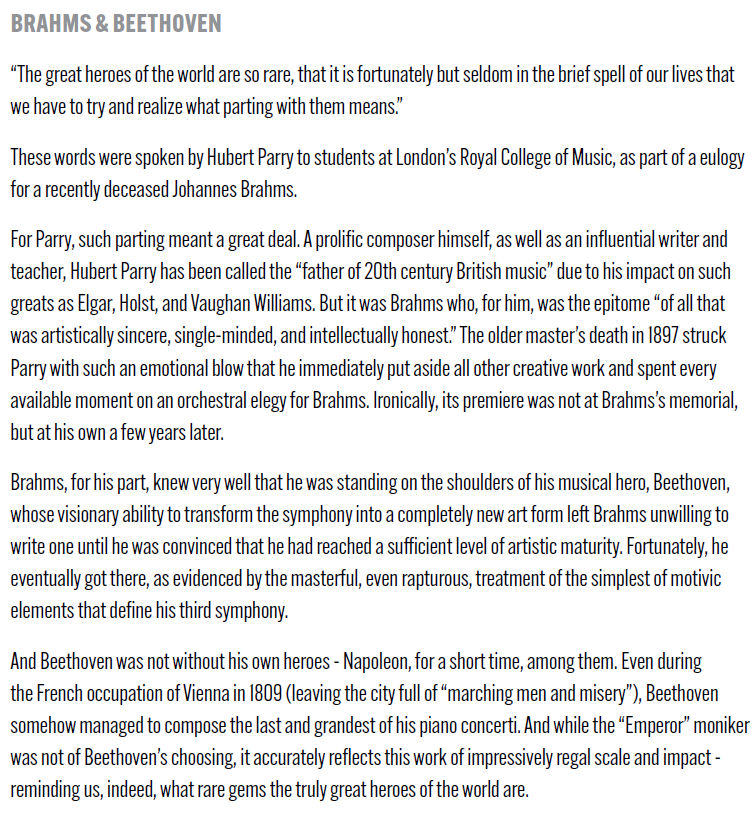
On October 16 & 17, Music Director Ruth Reinhardt and the Rhode Island Philharmonic Orchestra will present BRAHMS & BEETHOVEN with pianist Denis Kozhukhin.
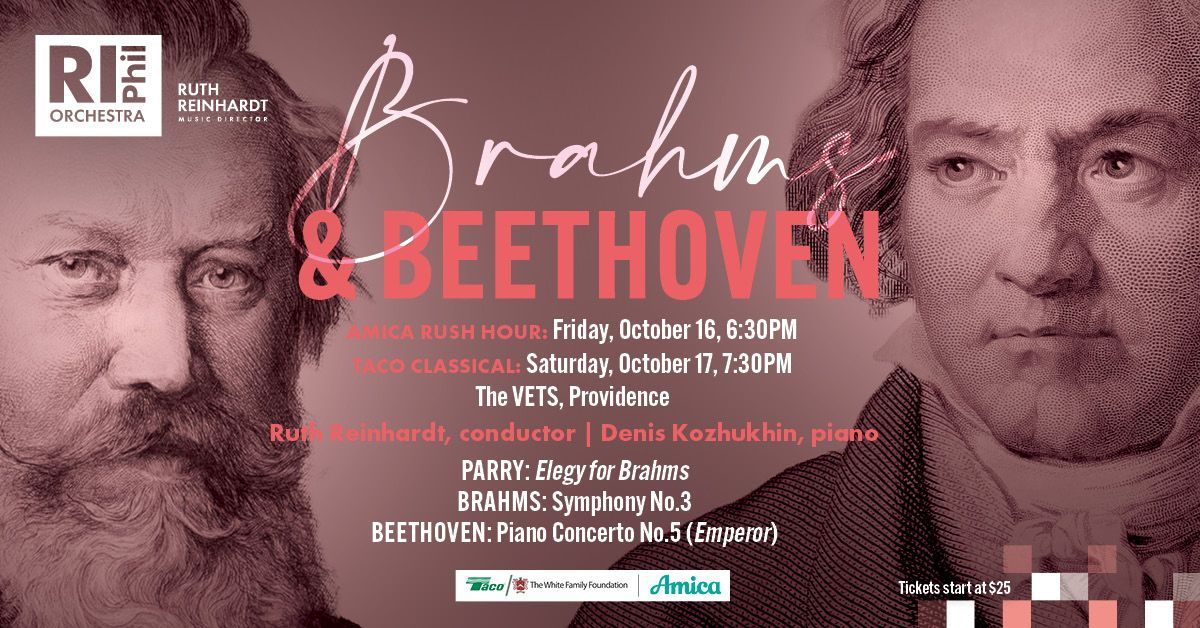
Title: Symphony No.3 in F major, op.90
Composer: Johannes Brahms (1833-1897)
Last time performed by the Rhode Island Philharmonic:
Last performed November 17, 2012 with Larry Rachleff conducting. This piece is scored for two flutes, two oboes, two clarinets, two bassoons, contrabassoon, four horns, two trumpets, three trombones, timpani and strings.
The Story: When Robert Schumann hailed Johannes Brahms as “a young blood at whose cradle the Graces and Heroes kept watch,” the praise, though well meant, helped trigger a severe creative crisis. Expectations that Brahms would become Beethoven’s heir as the next great symphonist weighed so heavily that it took him more than twenty years to complete his First Symphony. Yet despite that work’s success—and his growing stature as both a pianist and a composer of exceptional piano, vocal, and chamber music—his native Hamburg passed him over (twice!) for the post of chief conductor of its Philharmonic Orchestra and Choir. So Brahms went to Vienna and, famously, grew a beard.
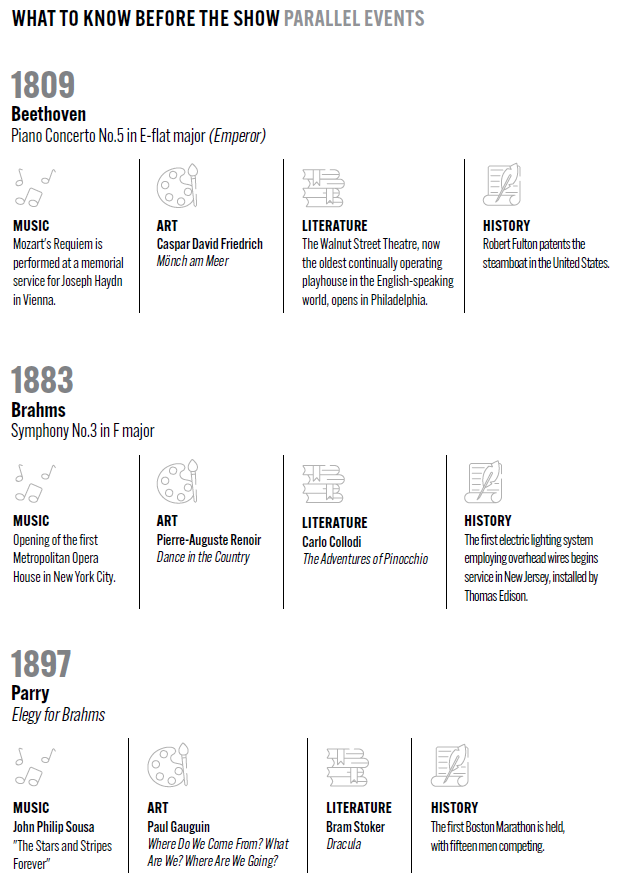
The move seems to have brought Brahms a new sense of freedom—and perhaps romance as well. In the spring of 1883, he heard the 26-year-old alto Hermine Spies sing several of his songs and was smitten. He invited her to his summer retreat in Wiesbaden, wrote her passionate letters, and composed two song cycles for her. Freed from his earlier anxieties, he was also writing symphonies suffused with a new sense of bliss, heard perhaps most clearly in the Third.
Brahms’s friends took note of this newfound joy. His protégé Antonín Dvořák exclaimed, “This work surpasses his first two symphonies—perhaps not in size and grand design, but certainly in beauty! What marvelous melodies are to be found there! It is all love, and one’s heart opens wide.” Clara Schumann was no less enthusiastic: “All the movements seem to be of one piece, one beat of the heart, each one a jewel! From start to finish one is wrapped about with the mysterious charm of the woods and forests. I could not tell you which movement I loved most.”
As Clara suggested, one of the symphony’s most striking features is its unifying three-note motif, F– Ab
–F, heard at the opening and recurring throughout. The motive was Brahms’s playful answer to the musical signature of his friend, the violinist Joseph Joachim: F–A–E, for
“Frei aber einsam”
(free but lonely). Brahms preferred
“Frei aber froh”
(free but happy), so he altered the notes accordingly, and built an entire symphony from the idea. The tension between major and minor is one of the work’s main engines, with A natural and A-flat set against each other from the first three chords onward. Another hallmark is its rhythmic instability, first heard in the opening theme, which hovers between duple and triple meter.
The second movement has the character of a wind serenade, marked by the earthy tone of the clarinet, and features an austere second theme that we will hear return in the finale. The delicately melancholic third movement begins with one of Brahms’s most beautiful cello melodies, but soon the major-minor shifts of the first movement return, creating an atmosphere of poignant ambiguity. Clara Schumann called this movement “a pearl, but it is a grey one dipped in a tear of woe.”
The fourth and final movement rises quietly but with mounting energy, growing from deep, somber rumblings into sparkling brilliance. Then something unexpected happens: it is as if all the unrest of the earlier movements suddenly and simultaneously erupts from the orchestra before eventually settling into a coda tinged with nostalgia. Once there, a gentle echo of the end of the first movement leads us home to F major.
Program Notes by Jamie Allen © 2026 ALL RIGHTS RESERVED.
Recommended Recordings:
Brahms Third Symphony has many fine versions. Otto Klemperer and the Philharmonia Orchestra of London recorded a complete Brahms symphony cycle (along with a towering reading of the German Requiem) in the 1950s and 1960s, now available on Warner Classics. It's a massive approach to Brahms, granitic, strong and imposing. And there are many, many others worth a listen: Arturo Toscanini, George Szell, Kurt Sanderling (Sony Classics), Herbert von Karajan (Deutsche Grammophon), Bernard Haitink (Philips) and Carlo Maria Giulini and Sir Adrian Boult (EMI, now Warner Classics.)
Tickets start at $25! Click HERE or call 401-248-7000 to purchase today!