THE STORY BEHIND: Parry's "Elegy for Brahms"
Share
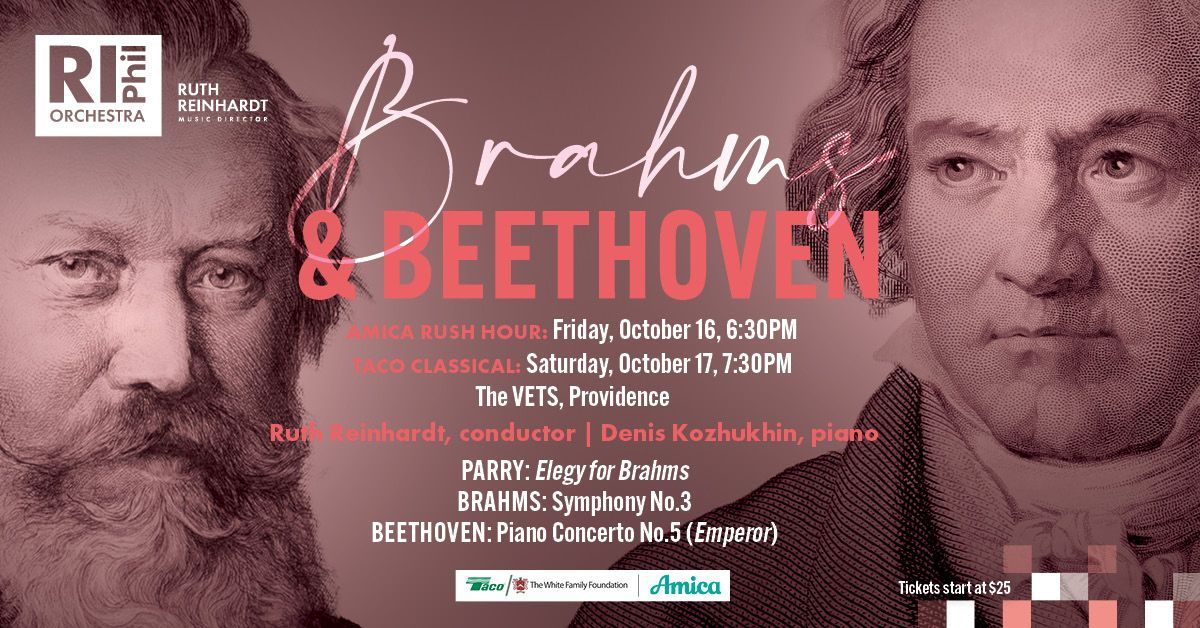
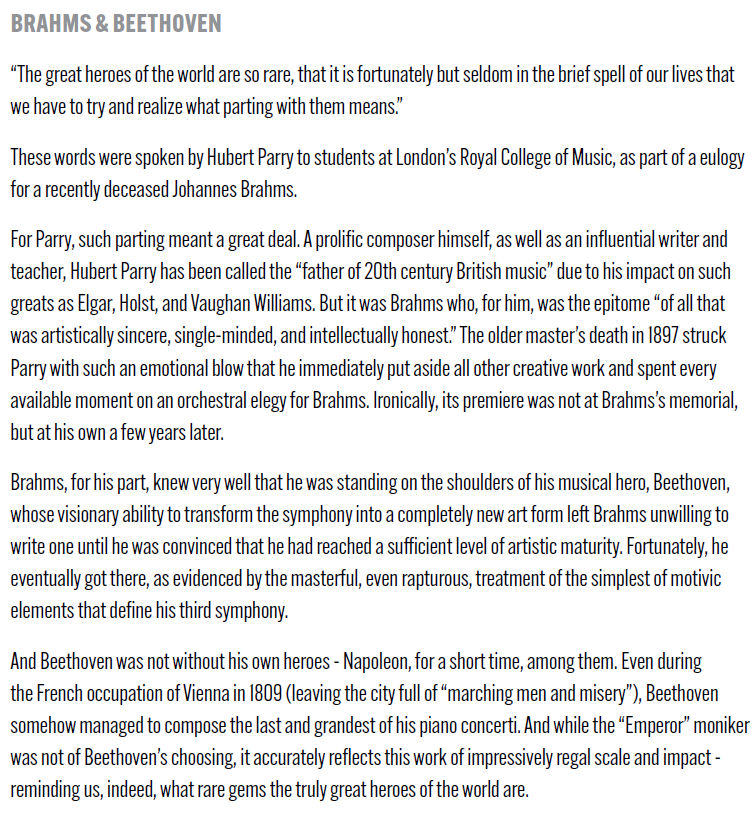
On October 16 & 17, Music Director Ruth Reinhardt and the Rhode Island Philharmonic Orchestra will present BRAHMS & BEETHOVEN with pianist Denis Kozhukhin.
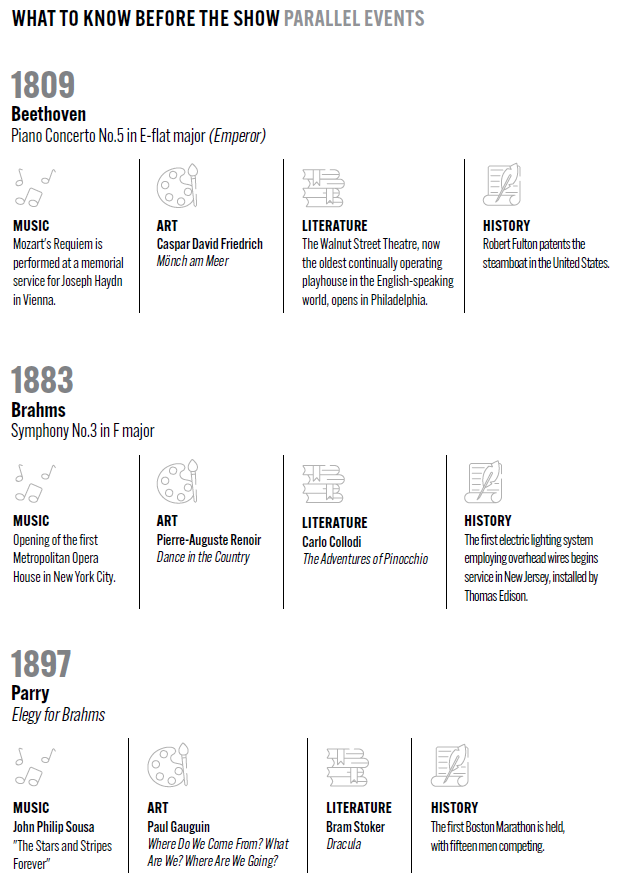
Title: Elegy for Brahms
Composer: Hubert Parry (1848-1918)
Last time performed by the Rhode Island Philharmonic:
This is a RI Philharmonic Orchestra premiere. This piece is scored for two flutes, two oboes, two clarinets, two bassoons, four horns, two trumpets, three trombones, tuba, timpani and strings.
The Story: A familiar story among composers, Hubert Parry’s parents regarded composition as a pastime rather than a profession. This was despite his extraordinary talent: while still a student at Eton, he became the youngest person ever to pass the Oxford Bachelor of Music examination. So, Parry dutifully studied law and history at Oxford and later worked as an underwriter at Lloyd’s of London. But he had a side-hustle writing entries for George Grove’s
Dictionary of Music and Musicians, which soon led to a full-time musical career. When Grove founded the Royal College of Music in London, he appointed Parry professor of music history—a role in which Parry thrived in for the rest of his life.
Parry’s admiration for Brahms was well known. He longed, in fact, to study with the German master. And while that dream was never realized, he did learn a great deal from close study of Brahms’s scores. His
Symphonic Variations, for instance, clearly reflect the language and structure of Brahms’s own “Haydn Variations.” (That influence, in turn, proved far-reaching: Parry’s work would subsequently inspire Edward Elgar’s iconic “Enigma Variations”).
In
Elegy for Brahms, “Parry uses the romantic orchestra with delicacy to convey his own sense of hollowness and loss,” writes American composer Bernard Benoliel. Fittingly, Brahms’s presence is felt throughout. Listen, for example, to the graceful way in which the second theme, played by shimmering clarinets, emerges from a series of sighing figures in the strings. Elements of other composers, such as Wagner and Tchaikovsky, can be heard here and there as well. But the piece’s inexorable, even spiritual ascent at the end is a brilliant stroke, reminiscent of the coda to Richard Strauss’s
Death and Transfiguration.
Although Parry was determined to finish the
Elegy in time, it was not, alas, ready for Brahms’s funeral. Ironically, the work didn’t receive its premiere performance until Parry’s own memorial service in 1918 - and then was not heard again until 1977. As a result, it is still unfamiliar to many audiences. Hopefully, more performances like tonight’s will help it earn its rightful place in the canon.
Program Notes by Jamie Allen © 2026 ALL RIGHTS RESERVED.
Recommended Recording:
Tickets start at $25! Click HERE or call 401-248-7000 to purchase today!