THE STORY BEHIND: Tchaikovsky's Symphony No.4
Share
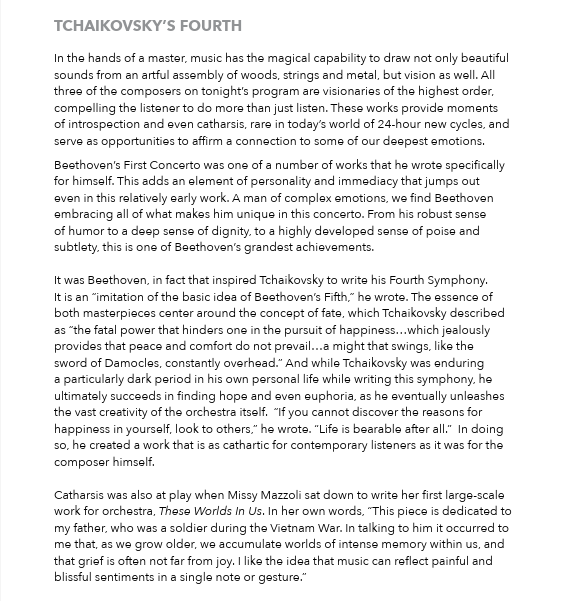
On March 13 and 14, conductor Marcelo Lehninger and the Rhode Island Philharmonic Orchestra will present TCHAIKOVSKY'S FOURTH with pianist Sara Davis Buechner.
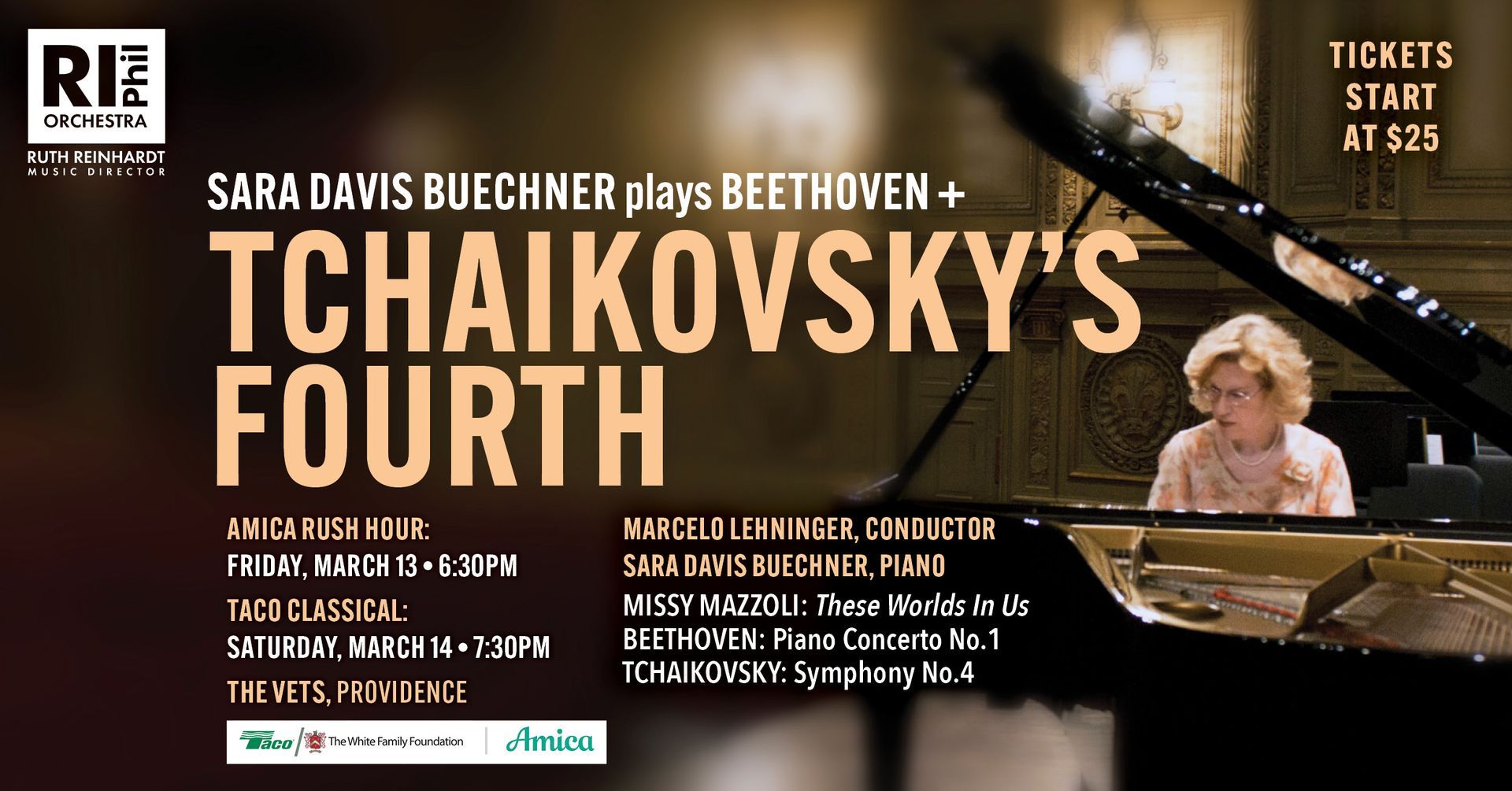
Title: Symphony No.4 in F minor, op.36
Composer: Pyotr Ilyich Tchaikovsky (1840-1893)
Last time performed by the Rhode Island Philharmonic:
Last performed January 19, 2018 with Ken-David Masur conducting. This piece is scored for piccolo, two flutes, two oboes, two clarinets, two bassoons, four horns, two trumpets, three trombones, tuba, timpani, percussion and strings.
The Story: “I adore terribly this child of mine; it is one of only a few works with which I have not experienced disappointment…this is my best symphonic work.”
-Pyotr Ilyich Tchaikovsky
Between 1877–1878, while writing his Fourth Symphony, Tchaikovsky wrote in his diary: “There is no doubt that for some months I was insane, and only now, when I am completely recovered, have I learned to relate objectively to everything which I did during my brief insanity. That man, who in May took it into his head to marry Antonina Ivanovna, who during June wrote a whole opera as though nothing had happened, who in July married, who in September fled from his wife, who in November railed at Rome and so on [including an attempted suicide] —that man wasn’t I, but another Pyotr Ilyich.”
But it was the mysterious figure of Nadezda von Meck, widow of a railway magnate, that helped pull the composer out of his darkest hours and start writing again. Providing both much-needed financial and emotional support, with the understanding that the two would never meet in person, von Meck was the one bright spot in the terrible year of 1877. He acknowledged her support by dedicating the Fourth Symphony to her, calling her only “my best friend” to ensure her privacy, and noted, “I thought of you in every bar.”
Of the first movement, Tchaikovsky wrote “The introduction… is the kernel, the quintessence, the chief thought of the whole symphony. This is Fate, the fatal power that hinders one in the pursuit of happiness from gaining the goal, which jealously provides that peace and comfort do not prevail, that the sky is not free from clouds—a might that swings, like the sword of Damocles, constantly over the head that poisons the soul. There is nothing to do but to submit and vainly to complain.” Heady words, but easy to hear as horn and bassoon fanfares herald a recurring motif that circles ominously throughout the movement. Listen for unabashed reliance on the brass for a sense of rampant anxiety, a trippy waltz for solo clarinet, and some particularly deft timpani writing.
By the second movement, in Tchaikovsky’s words, “life has you tired out. Many things flit through the memory…there were happy moments when young blood pulsed warm and life was gratifying. There were also moments of grief and of irreparable loss. It is all-remote in the past. It is both sad and somehow sweet to lose oneself in the past. And yet, we are weary of existence.” Oboe takes the lead here, with the support of pizzicato strings, in painting a picture of such melancholy that it seems to hang like a cloud in the air.
The third movement is full of music one might hear “after one has begun to drink a little wine, and is beginning to experience the first phase of intoxication” (a condition Tchaikovsky himself knew well). Listen for a lively Russian dance and quixotic oboe duet, as the gaiety rolls on, almost incoherently. To hear Tchaikovsky tell it, “The imagination is completely free and for some reason has begun to paint curious pictures…disconcerted images pass through our heads as we begin to fall asleep.”
In the finale, we are exhorted to “Go among the people. See how they understand how to be happy…If you cannot discover the reasons for happiness in yourself, look at others. Upbraid yourself and do not say that the entire world is sad…Take happiness from the joys of others. Life is bearable after all.” In this virtuosic showcase for the orchestra, listen for a musical quote from the charming Russian folksong “In the Fields There Stands a Birch Tree”, an exuberant and majestic march, a persistent return of the Fate motif (lest we forget it is always there), and a frenetic race to a crashing – and cathartic - conclusion.
Program Notes by Jamie Allen © 2025 ALL RIGHTS RESERVED.
Recommended Recordings:
Tchaikovsky's Fourth Symphony has many recommendable versions. Both Eugene Ormandy with the Philadelphia Orchestra and Herbert von Karajan with the Berlin Philharmonic left multiple recordings of the Fourth on multiple labels. The playing is sumptuous and passionate. Worth seeking out is a 1929 recording with Willem Mengelberg and the Concertgebouw Orchestra, very different in style and gives a sense of how this music was performed at the turn of the last century.
Tickets start at $25! Click HERE or call 401-248-7000 to purchase today!