THE STORY BEHIND: Beethoven's Piano Concerto No.1
Share
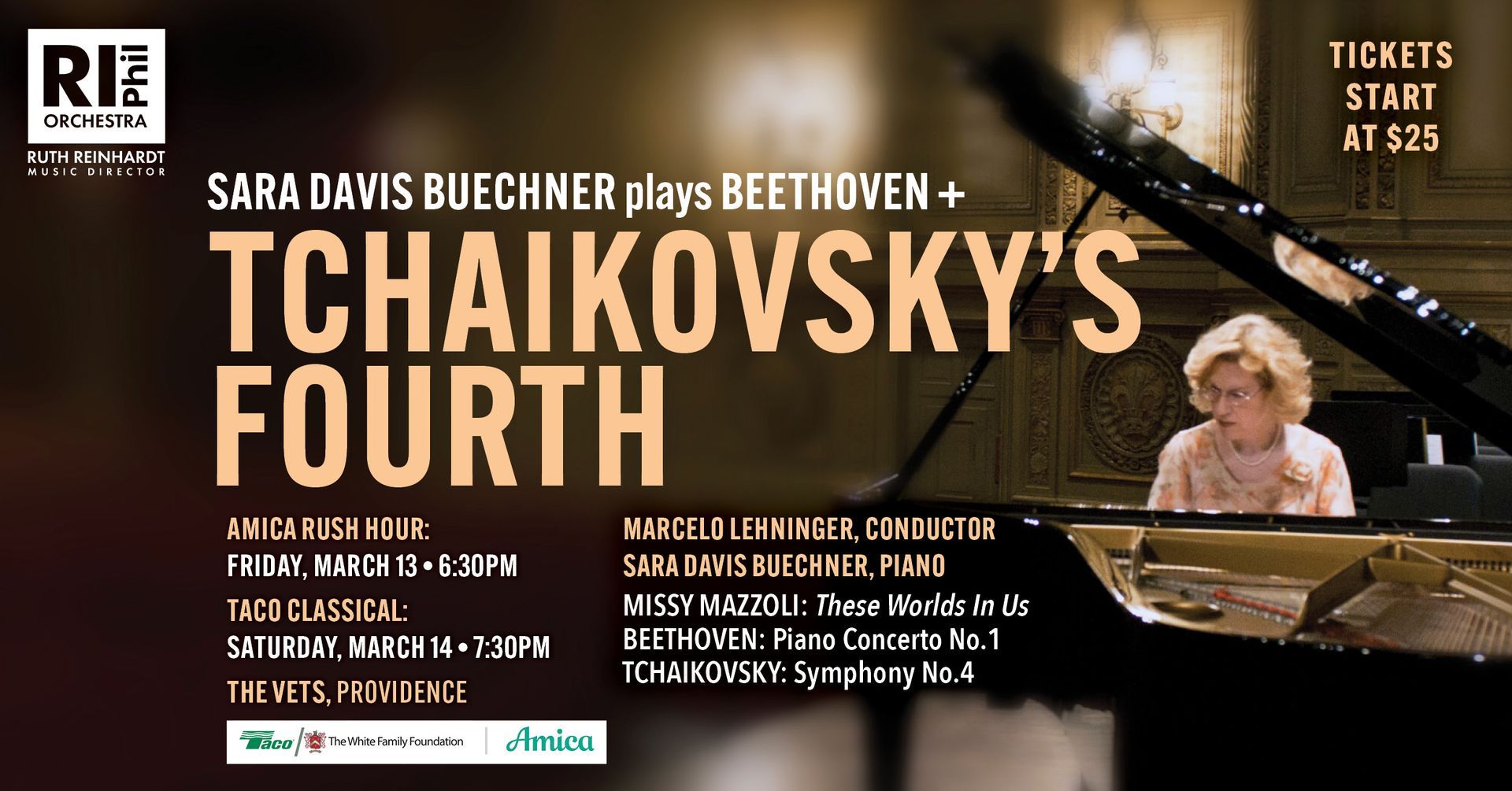
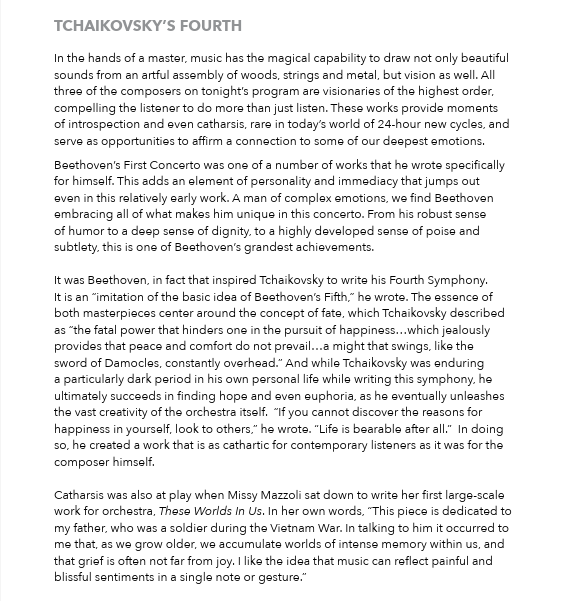
On March 13 and 14, conductor Marcelo Lehninger and the Rhode Island Philharmonic Orchestra will present TCHAIKOVSKY'S FOURTH with pianist Sara Davis Buechner.
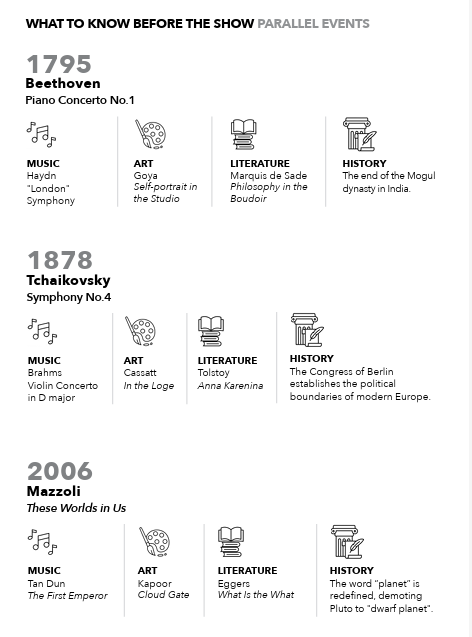
Title: Piano Concerto No.1 in C major, op.15
Composer: Ludwig van Beethoven (1770-1824)
Last time performed by the Rhode Island Philharmonic:
Last performed May 10, 2014 with Larry Rachleff conducting and soloist Alon Goldstein. In addition to a solo piano, this piece is scored for flute, two oboes, two clarinets, two bassoons, two horns, two trumpets, timpani and strings.
The Story: Beethoven Piano Concerto in C major was the first of his piano concertos to be published, but the third to be written. He had written two others while he was in his teens. But it is here, at the mature age of 25, that Beethoven begins to display his trademark original touches of color, drama, rhythmic intrigue, and unusual shifts of key.
Compared to other concerti of the time, this is a long work (precisely how long depends on the cadenza), but it boasts such a rich mix of poise and humor that one barely notices the time passing. Mozart had long been Beethoven’s idol, the young musician having heard and performed many of Mozart’s works while still living in his native city of Bonn and playing viola in the Court Orchestra of neighboring Cologne. And there are unmistakable signs of Mozart’s influence here. But Beethoven was spreading his wings, and strove for something bolder and more expansive than his model. Offbeat accents were one way of distinguishing himself from his idol, but even stronger evidence of this boldness lies in his penchant for slyly shifting to remote keys, and the way in which he revels in exploring the darker subtext of even the most cheerful of melodies.
All of this is in evidence during the lengthy orchestral opening of the concerto, with its contrast of marches and lyrical melodies. When the soloist finally enters, Beethoven soon draws us into a dramatic and mysterious development section that sets the stage for a breathless cadenza (which Beethoven himself most likely improvised at its premiere performance).
The second movement,
Largo, is set in the unexpected and remote key of A-flat major, and begins with a lovely eight-measure song played by the soloist with only the gentlest of accompaniment from the strings. The winds then take over, creating a restrained backdrop that allows the principal clarinet ample opportunity to shine. While the overall structure of the movement is a simple ABA, one gets the sense, not that beautiful melodies are simply repeating, but that a story is unfolding.
The finale, a seven-section
Rondo, is a high-spirited affair. Each time we hear it, the rondo theme is delivered at high voltage by the piano, then repeated, forte, by the whole orchestra. Listen for woodwind fanfares, delightful harmonic shifts and changes in orchestration, and thoughtful uses of the minor mode until the soloist launches into a tantalizingly brief cadenza. At the last appearance of the rondo theme, the piano gradually becomes quieter and slower, departing almost unnoticed, spinning new improvisations on the theme as it goes. The oboes then say a sad farewell before the whole orchestra closes the movement with a sudden, short blaze of color.
Program Notes by Jamie Allen © 2025 ALL RIGHTS RESERVED.
Recommended Recordings:
There are many fine recordings of the Beethoven Piano Concertos. Alfred Brendel (Philips/Decca), Rudolf Serkin (Sony), Claudio Arrau (Philips/Decca), Glenn Gould (Sony), Maurizio Pollini (Deutsche Gramophone) are all quite fine. The set of the five with Leon Fleisher, George Szell and The Cleveland Orchestra (Sony), after more than 60 years, still stands as one of the great statements of the cycle. Though she never recorded all the concertos, Martha Argerich's recording of the First Concerto (Deutsche Gramophone) exhibits the poetry and fire of her playing.
Tickets start at $25! Click HERE or call 401-248-7000 to purchase today!