THE STORY BEHIND: Stravinsky's "Firebird" Suite (1919)
Share
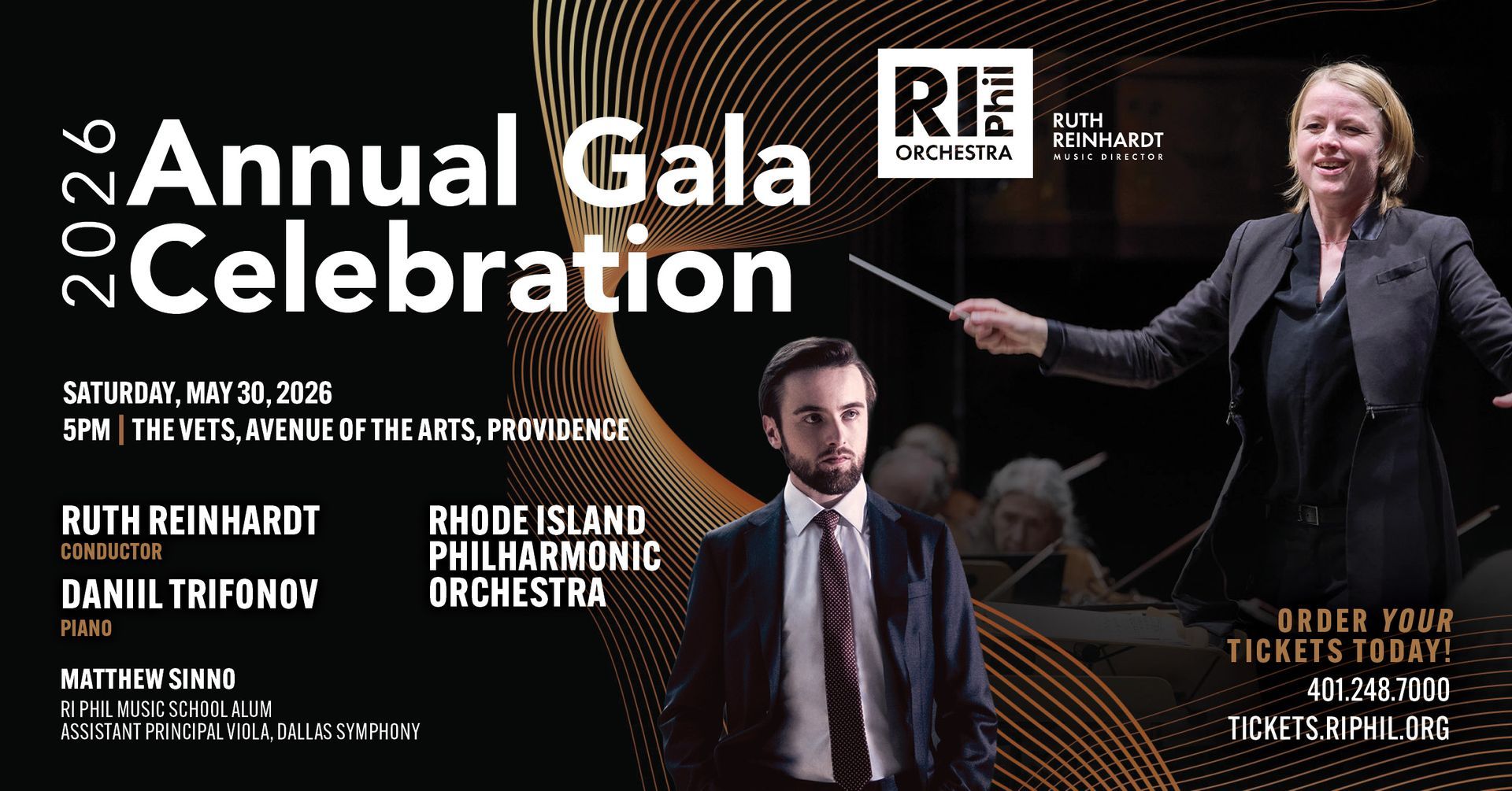
On May 30, Music Director Ruth Reinhardt and the Rhode Island Philharmonic Orchestra will present 2026 ANNUAL GALA CELEBRATION: TRIFONOV PLAYS RACHMANINOFF with pianist Daniil Trifonov.
Title: The Firebird: Suite (1919)
Composer: Igor Stravinsky (1882-1971)
Last time performed by the Rhode Island Philharmonic:
Last performed June 1, 2014 with Larry Rachleff conducting. This piece is scored for two flutes, piccolo, two oboes, English horn, two clarinets, two bassoons, four horns, two trumpets, three trombones, tuba, timpani, percussion, harp, piano and strings.
The Story: Igor Stravinsky, though irrefutably known today, alongside Bartók, as one of the giants of modern music, was not Sergei Diaghilev’s first choice for an ambitious new project designed to the centerpiece for 1910 Paris season of the newly formed Ballet Russes.
The Firebird, based on a character from Russian folklore symbolizing rebirth, beauty, and magic, was to be a comprehensive, seamlessly integrated work of art encompassing music, theater, and visual design, so not just any composer would do.
But Diaghilev’s first choice, Alexander Tcherepnin, dropped out due to artistic differences with the choreographer, Michael Fokine. So he offered the work to an extremely busy Anatoly Lyadov, who never seemed to get around to it and was basically fired. Diaghilev briefly considered Alexander Glazunov, then Russia’s leading composer, but he didn’t bite either. So, pressed for time, Diaghilev gambled on a young, unknown Igor Stravinsky, who had only orchestrated two pieces by Chopin for Diaghilev the year before. But even this young journeyman had his doubts: “The Firebird
did not attract me as a subject. Like all story ballets it demanded descriptive music of a kind I did not want to write. I had not yet proved myself as a composer…in truth my reservations about the subject were a defense for my not being sure I could… I was flattered, of course, by the promise of a performance of my music in Paris…”
Fortunately, in the end, he could not turn the offer down and, in the course of a single night, Stravinsky’s star became a supernova. Having been a protégé of Rimsky-Korsakov, a master teacher and one of the most adroit orchestrators in musical history, Stravinsky had an instinct for creating dazzling orchestral colors that were perfect for the exotic Russian story assembled by designer, Alexandre Benois and choreographer, Michel Fokine. The title character, whose feathers flow with iridescent luminosity and can serve both good and evil, depending on its mood, is depicted musically by virtuoso figurations in the woodwinds and harp glissandi. Listen for the ethereal sound of violins playing sul ponticello (near the bridge) and shuddering with anxious tremolos. Then allow yourself to be entranced by the irredeemably evil magician, Kashchei, who is depicted with chromatic complexities that lead to an “Infernal Dance,” replete with snarling brass, angular, jagged motifs, and pounding, insistent, off-kilter rhythms.
In the midst of the chaos, the Firebird swoops in again to lull Kashchei and his minions into deep slumber with an entrancing “Berceuse” (listen for the famous languid bassoon solo). While they sleep, the Firebird gives a prince who has fallen in love with one of the princesses held captive by Kashchei the secret to killing the evil magician (destroying the giant egg in which his soul resides). That done, a solo horn dramatically intones an evocation of the arrival of the sun and the triumph of good over evil. In time, the whole orchestra takes up its tune, accompanied by slow, rising scales and, finally, pounding brass chords lead to the grand, immortal ending.
Program Note by Jamie Allen © 2026. ALL RIGHTS RESERVED.
Recommended Recordings:
Tickets start at $40! Click HERE or call 401-248-7000 to purchase today!