THE STORY BEHIND: Eric Nathan's Violin Concerto ("The Mountains We Climb")
Share
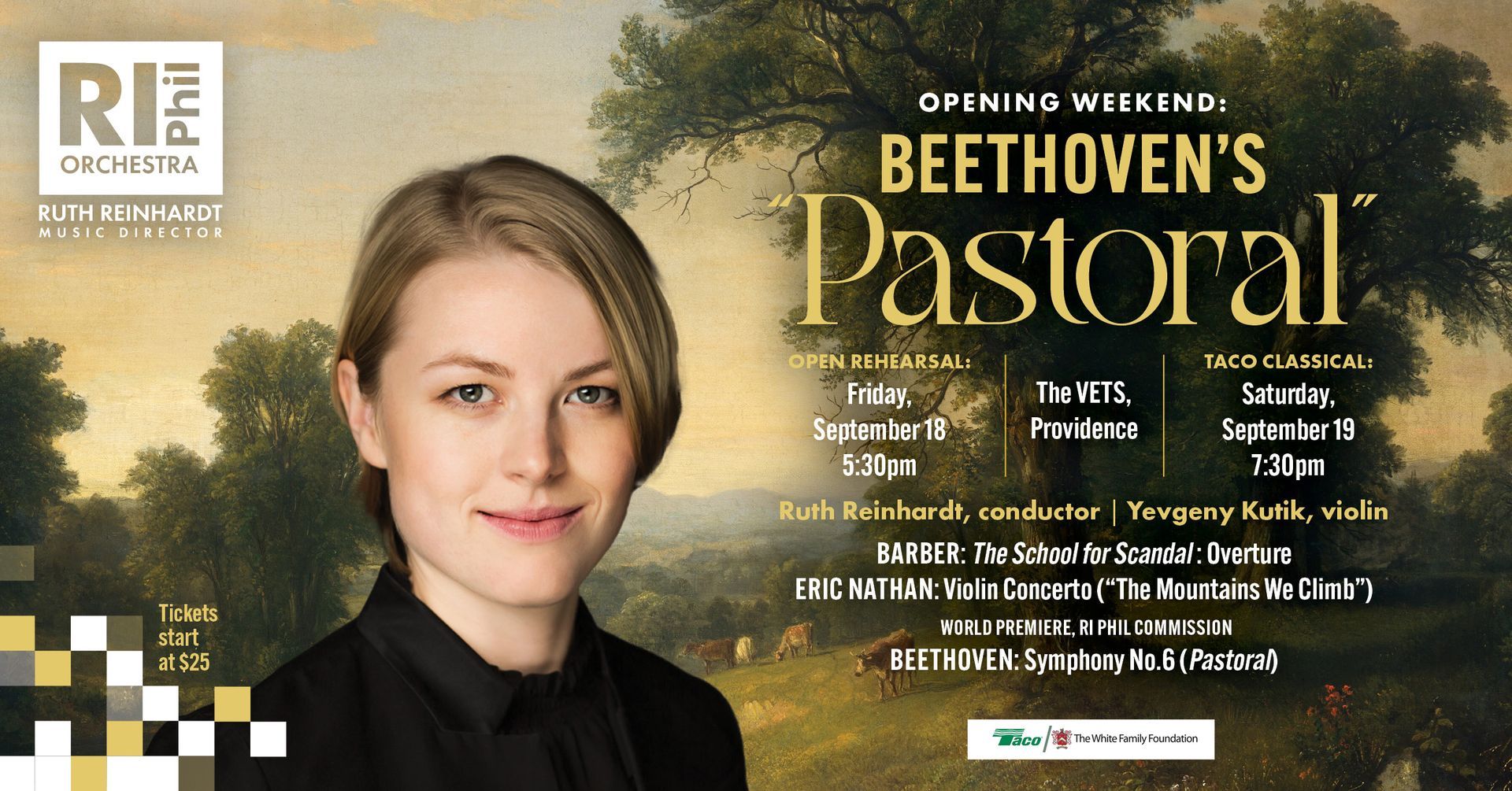
On September 18 & 19, Music Director Ruth Reinhardt and the Rhode Island Philharmonic Orchestra will present BEETHOVEN'S "PASTORAL" with violinist Yevgeny Kutik.

Title: Violin Concerto ("The Mountains We Climb")
Composer: Eric Nathan (1983- )
Last time performed by the Rhode Island Philharmonic:
This is a RI Philharmonic Orchestra premiere. In addition to a solo violin, this piece is scored for piccolo, two flutes, two oboes, clarinet, bass clarinet, two bassoons, contrabassoon, four horns, two trumpets, two trombones, tuba, timpani, percussion, harp and strings.
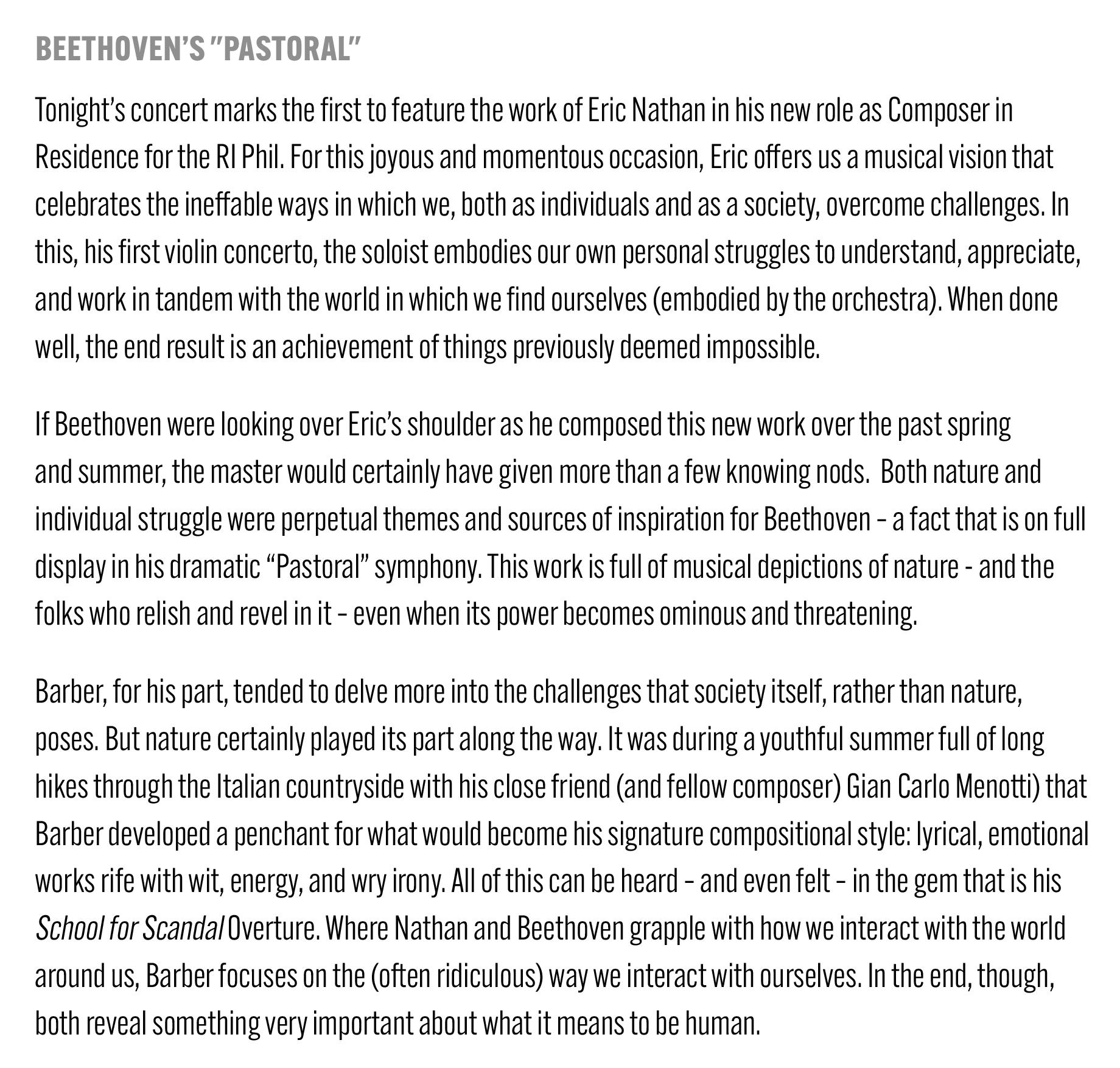
The Story: Notes by the composer:
I began composing this work at the start of the new year at a mountaintop residency in Italy. As I composed, I looked out at another mountain across the valley, framed by my window. I was struck by how the landscape shifted dramatically from day to day: from tranquil to stormy, from rolling pastures to an austere blanket of windswept snow. The mountain was immovable yet these changes in the environment had an outsize impact on the world it seemed to anchor.
On New Year's Eve, I spent the evening with two refugee poets from Ukraine, who have made that mountaintop their new home since the start of the war in their country. As the new year arrived, I went to the piano and searched for a song to play that we all knew. I chose “Amazing Grace.” After I finished, one of them quietly recited the final lyric aloud: “was blind, but now I see.” We sat with those words. I told them I hoped the new year would bring them home. A few days later, I penned my first notes.
The central idea of my Violin Concerto is the ascent of a mountain. This climb is both literal and symbolic, representing a striving to surmount challenges greater than oneself. The orchestra gives voice to the mountain, a monumental force composed of a multitude, with which the lone soloist is put into dialogue. The conductor evokes sounds of the natural world through sweeping gestures, sending waves of sound across the stage that take us outside of the concert hall.
This concerto differs from many canonical concertos of the past in that its three movements follow a single dramatic arc with one set of themes that evolve over its span. The movements are titled Act I, Act II, and Act III, each a new scene in an unfolding narrative.
Act I begins with the introduction of the two central motives of the work: the stable interval of a perfect fifth, beginning first as a drone and later turning into a melodic leap; and the unstable half-step, the smallest building block of music that can tilt the music from major to minor, a seismic harmonic shift. Both work together to create harmonies that move in and out of focus, guiding the emotional landscape and evoking the blues in a distant way: a tradition that holds grief and hope in the same breath, joining major and minor together at once. The music begins with a sacred expansiveness and continues through varied sonic terrain.
Act II begins in a darker place. The soloist enters and begins a lamenting dialogue with three muted violins in the orchestra that gradually draws the full string orchestra into weeping song. The soloist climbs toward the summit step-by-step up a sonic staircase laid out by the orchestra.
Act III begins atop the mountain. We hear an oboe begin to sing a melody that the solo violin ultimately fully embraces in the final cadenza. Something gradually comes into focus for the soloist and audience together, shining new light on what came before.
Tonight’s world premiere has special meaning for me. Yevgeny Kutik came to America as a young refugee from Belarus and grew up in the Berkshire Mountains of Massachusetts, a landscape I know well having spent my summers at Tanglewood since I was a child, a place where I met Norman Solomon. Ruth Reinhardt, who leads tonight's performance, lives in the Swiss Alps, and has spoken to me of how much those mountains mean to her.
The concerto was commissioned at the behest of Norman Solomon and grew into a collaborative enterprise: a consortium of three violinists and eight orchestras premiering the work across the United States, each bringing their own interpretation to the climb, and by doing so, joining together as a larger community. Each soloist’s voice has found its way into the score.
This concerto was commissioned by Norman Solomon, M.D. and co-commissioned by the Rhode Island Philharmonic Orchestra, The Saint Paul Chamber Orchestra, Montgomery Symphony Orchestra, Boise Philharmonic, Bay Atlantic Symphony, Friends of Chamber Music and Two Rivers Chamber Orchestra, Stanford Symphony Orchestra, and Hopkins Symphony Orchestra. It is dedicated to violinists Yevgeny Kutik, Curtis Stewart and Stefan Jackiw, who will give the premiere performances, and to Norman Solomon, M.D., with gratitude.
Program Note by Eric Nathan © 2026 ALL RIGHTS RESERVED.
Tickets start at $25! Click HERE or call 401-248-7000 to purchase today!