THE STORY BEHIND: Handel's "Messiah"
Share
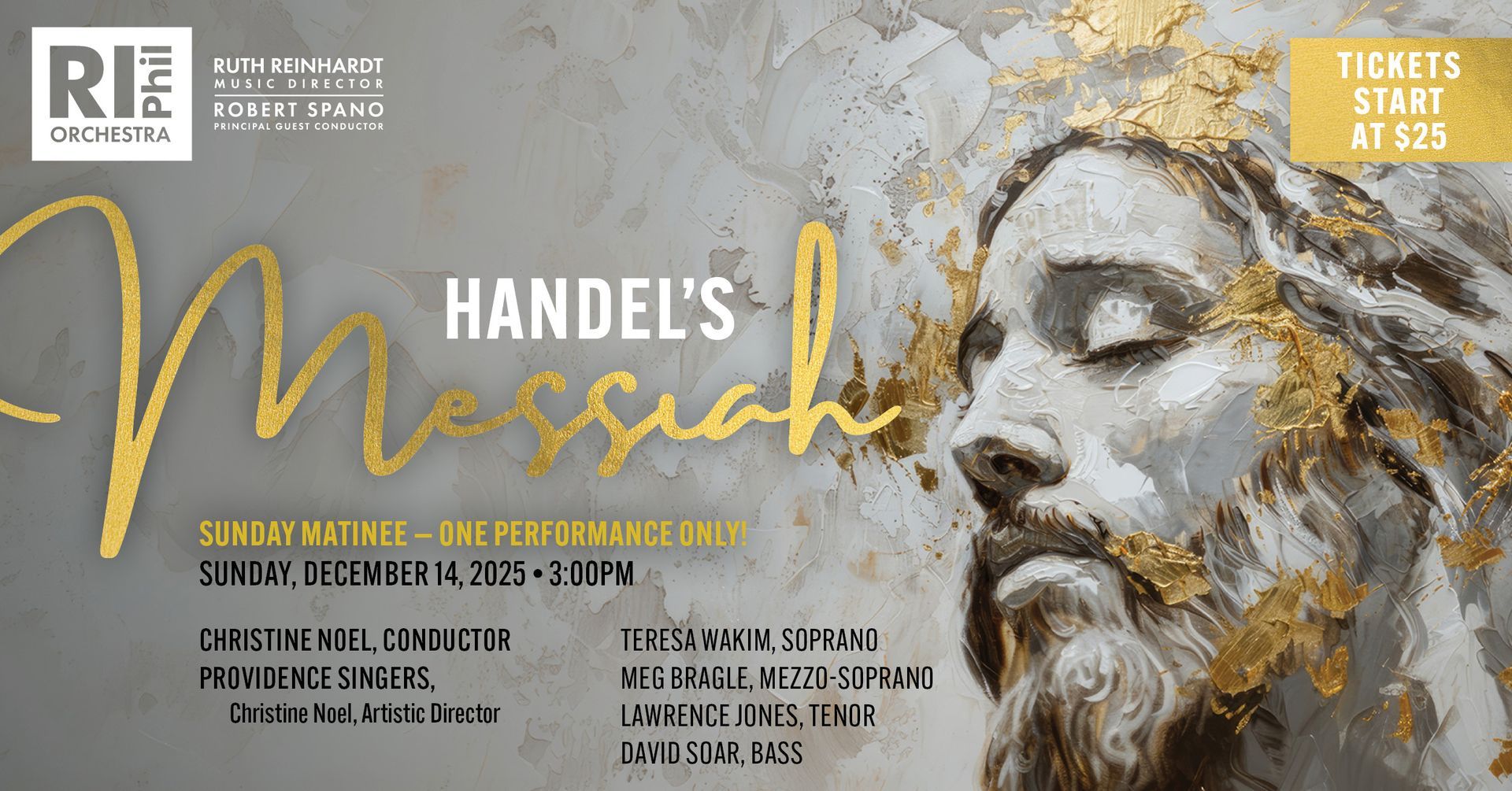
On December 14, conductor Christine Noel and the Rhode Island Philharmonic Orchestra will present HANDEL'S MESSIAH with Providence Singers, soprano Teresa Wakim, mezzo-soprano Meg Bragle, tenor Lawrence Jones and bass David Soar.
Title: Messiah, HWV 56
Composer: George Frideric Handel (1685-1759)
Last time performed by the Rhode Island Philharmonic: Last performed December 15, 2024 with Christine Noel conducting, Providence Singers and soloists Eleonore Cockerham, Tamara Mumford, Thomas Cooley and Douglas Williams. In addition to a chorus and solo soprano, alto, tenor and bass, this piece is scored for two oboes, bassoon, two trumpets, timpani, continuo and strings.
The Story: When Handel made a visit from his native Germany to England in 1710, he had no intention of settling there. But he did have reason to believe that the visit would be profitable. Recent attempts by local composers to establish an appetite for Italian Opera in London seemed to be bearing fruit. But no one on the planet could hold a candle to Handel when it came to writing Italian-style opera in the early 1700s. Within four months of setting foot on British soil, he successfully mounted a production of his new work
Rinaldo, which proved to be such a success that Queen Anne herself let him know that, were he to return on a more permanent basis, he would enjoy guaranteed patronage from both the crown and the aristocracy.
Handel gladly accepted the offer and, for many years, rode wave after wave of success in his newly adopted country. But public taste is a fickle thing, and society was changing. Patronage of the arts was gradually shifting from the aristocracy to the middle classes. And the middle classes, accustomed to the plays of Shakespeare and his contemporaries, clamored for on-stage action and English language texts that they could understand. Opera at the time, where most of the real action happened off stage and soloists merely sang about it (in Italian, no less), was a hard sell to the 18th century ticket buying public. The playwright Samuel Johnson succinctly summed up the general British opinion of opera as an “exotic and irrational entertainment.”
So, reading the writing on the wall, Handel took it upon himself to invent an entirely new form – the English oratorio – a completely different animal from the Italian oratorios he had written earlier in his career. Where the choruses in his early work were subordinate and simple, this new invention took advantage of a burgeoning tradition of choral music in England and featured the grandest of choruses that would not only command center stage but ring through the ages as well.
His first foray into this new form was called Esther, a dramatic spin on an Old Testament story about a Persian Queen who devises a clever plan to save all the Jews in her country from imminent slaughter. Despite its lack of sets and acting, the music was so new and compelling that audiences clamored for more. Esther enjoyed many successful revisions in subsequent London seasons, and its memorable grand chorus at the end foretold even greater things on the horizon.
In August of 1741, Handel received an invitation to present a concert for the benefit of Dublin’s charities. In a head-spinningly short period of 24 days (although one might make the argument that this piece had been percolating within him for a decade or so), Handel produced what we now know as Messiah. Powerful puritanical elements in England, who couldn’t abide the thought of something called “Messiah” being defiled by a presentation in such a sinful venue as a theater, forced its first appearances to be billed as simply “a new sacred oratorio,” But its timeless and universal message of redemption, faith, and hope, brimming with majestic choral passages and poignant arias, soon began resonating with audiences not just as a religious text but also as a celebration of the human condition.
Throughout, Handel blends dramatic choral movements with delicate solo arias, creating an emotional journey for the listener, and his expert use of the orchestra creates a vibrant sound that evokes the joy and reverence of the text. But pay attention, if you will, to the way in which he achieves crystal clarity in even the most complex of musical moments. This bit of sublime magic on the part of the composer means that there is always something for everyone, from the most ardent music enthusiast to the casual listener. And even in the grandest moment, there is always something ineffable that strikes us on a deeply personal level.
Program Notes by Jamie Allen © 2025. ALL RIGHTS RESERVED
Tickets start at $25! Click HERE or call 401-248-7000 to purchase today!