THE STORY BEHIND: Rachmaninoff's Piano Concerto No.2
Share
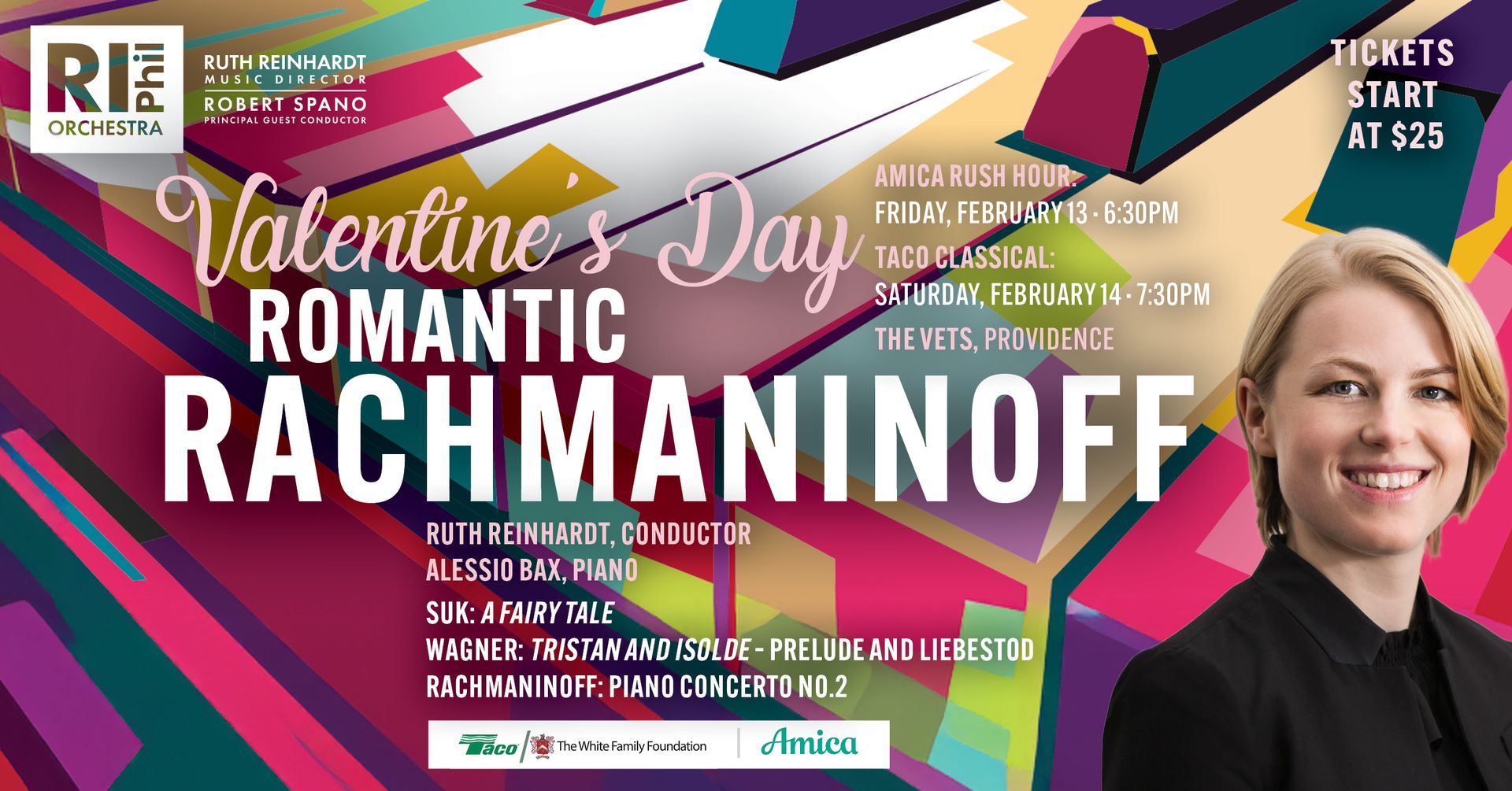
On February 13 and 14, Music Director Ruth Reinhardt and the Rhode Island Philharmonic Orchestra will present ROMANTIC RACHMANINOFF with pianist Alessio Bax.
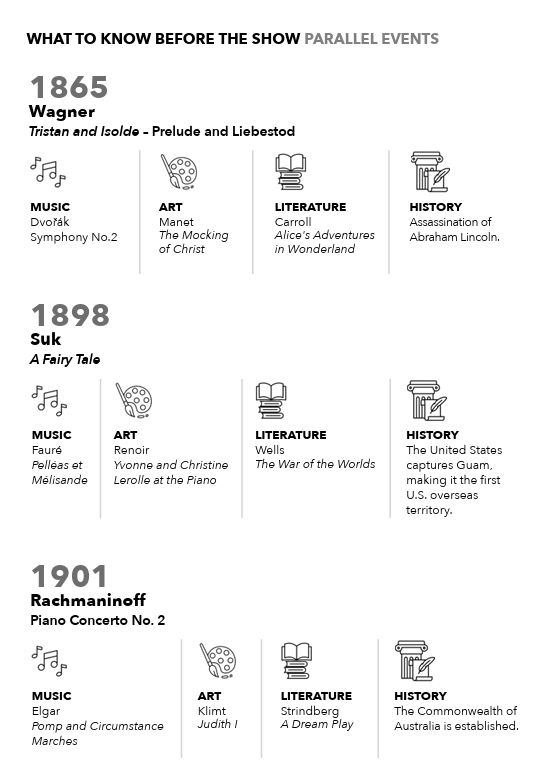
Title: Piano Concerto No.2 in C minor, op.18
Composer: Sergei Rachmaninoff (1873-1943)
Last time performed by the Rhode Island Philharmonic:
Last performed February 17, 2018 with Michael Christie conducting and soloist William Wolfram. In addition to a solo piano, this piece is scored for two flutes, two oboes, two clarinets, two bassoons, four horns, two trumpets, three trombones, tuba, timpani, percussion and strings.
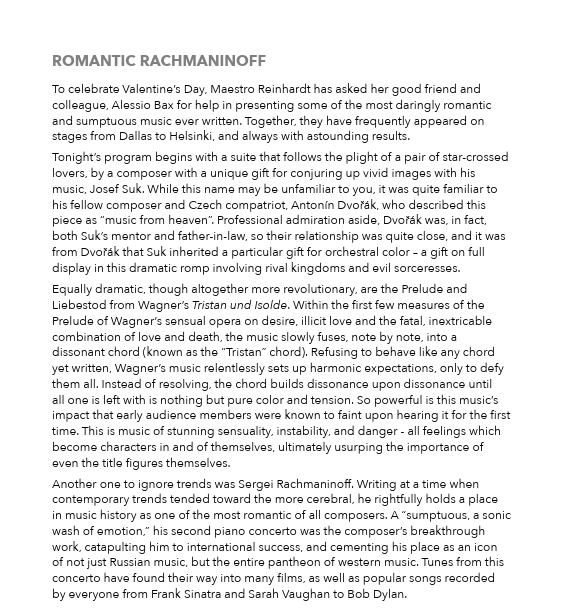
The Story: One of the few serious composers of the early twentieth century that eschewed contemporary trends was the Russian great Sergei Rachmaninoff. Anachronistically, he retains a place in music history as one of the most romantic of all composers.
Spurred on by his hypnotherapist with mantras such as “You will begin to write your concerto,” “You will work with great facility,” and “Your concerto will be of excellent quality,” Rachmaninoff managed to pull himself out of the creative slump he’d experienced during the last three years of the
19th
century, and created a sumptuous, sonic wash of emotion that he, fittingly, dedicated to the encouraging doctor.
A performer of some acclaim already, Rachmaninoff premiered the new concerto with the Moscow Philharmonic in 1901. It quickly became a breakthrough showcase for the composer, catapulting him into the international spotlight, and providing memorable melodies for countless film scores and popular songs.
On the one hand, it’s a virtuoso showpiece. On the other hand, it is remarkably subtle and transparent, almost chamber-like in fact. At several points, the piano even melts into the orchestra, becoming just another textural ingredient in the main course.
The compact three movements demand from the soloist speed, dexterity, and endurance, as well as sensitivity to subtle dynamic and rhythmic shadings. The opening Moderato starts with the pianist chiming chords as if he were ringing a bell, calling the orchestra to join in the music making. Once all the forces are gathered, the piano leads everyone in a Russian folk–flavored motive until a solo horn ventures into unexpected harmonic terrain. But the errant horn is quickly reigned in as pianist and orchestra gallop together to a resounding finish.
The Adagio sostenuto, one of many passages to find themselves enshrined in pop culture, opens with a series of slow chords in the strings which modulate from the C minor of the previous movement to the E major of this movement. Bach-like arpeggios in the piano invite the flute and clarinet to introduce the main theme, who then respectfully pass it off to the piano and strings until the soloist uses it as fodder for a fearsome cadenza. Eventually, things calm back down, and the pianist begins to channel the spirit of Bach once more while the rest of the instruments, one by one, stop to listen.
The Allegro scherzando opens with a short orchestral introduction that modulates from E major back to C minor, before a series of elaborate flourishes in the piano lead us to an agitated first theme. The oboe and violas then introduce the unforgettable melody that would eventually become known as “Full Moon and Empty Arms,” recorded by Frank Sinatra, Sarah Vaughan, and many others. The melody continues to bloom and blossom with suspense and anticipation until the first theme returns as the basis for a stormy, almost improvisatory development. The movement closes with a kaleidoscopic play of light and dark that exposes as yet unexplored elements of all we’ve heard before with such grace that contemporary piano great Steven Hough once mused “It sounds as if it wrote itself, so naturally does the music flow".
Program Notes by Jamie Allen © 2025 ALL RIGHTS RESERVED.
Recommended Recordings:
Rachmaninoff's Second Piano Concerto has been recorded over 100 times, beginning with Rachmaninoff himself. His 1929 RCA account with Stokowski and The Philadelphia Orchestra holds up after almost a century; one hears the work in the composer's own voice. The American pianist William Kapell made a powerful recording in 1950 (RCA.) There are many fine stereo versions, and recommended are Vladimir Ashkenazy with Bernard Haitink and the Concertgebouw Orchestra (Decca), Earl Wild with Jascha Horenstein and the Royal Philharmonic (Chandos), Sviatoslav Richter with the Warsaw National Philharmonic (Deutsche Grammophon), and most recently, Stephen Hough's dynamic account of all the concertos on Hyperion.
Tickets start at $25! Click HERE or call 401-248-7000 to purchase today!