THE STORY BEHIND: R. Strauss's "Tod und Verklärung"
Share
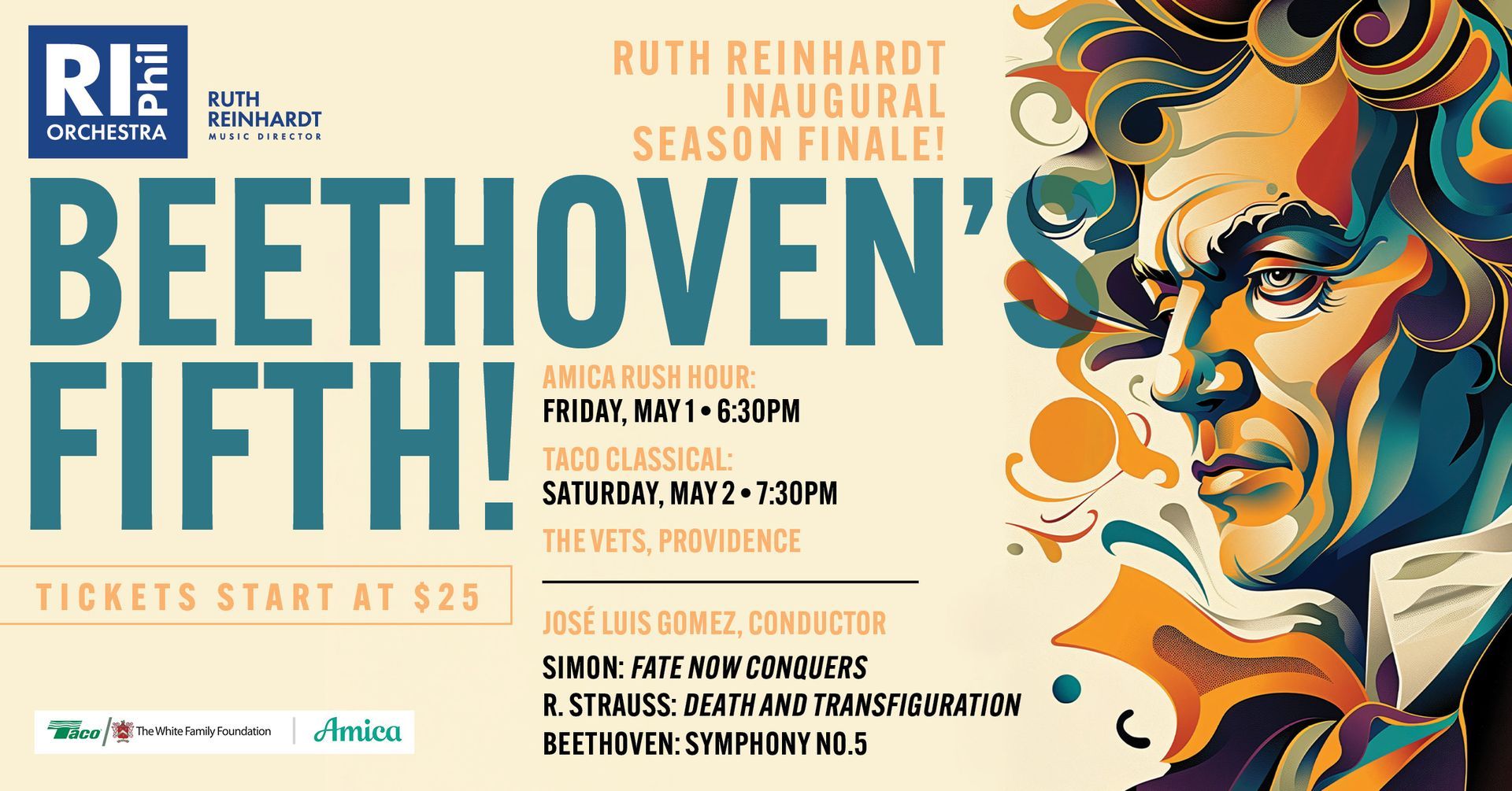
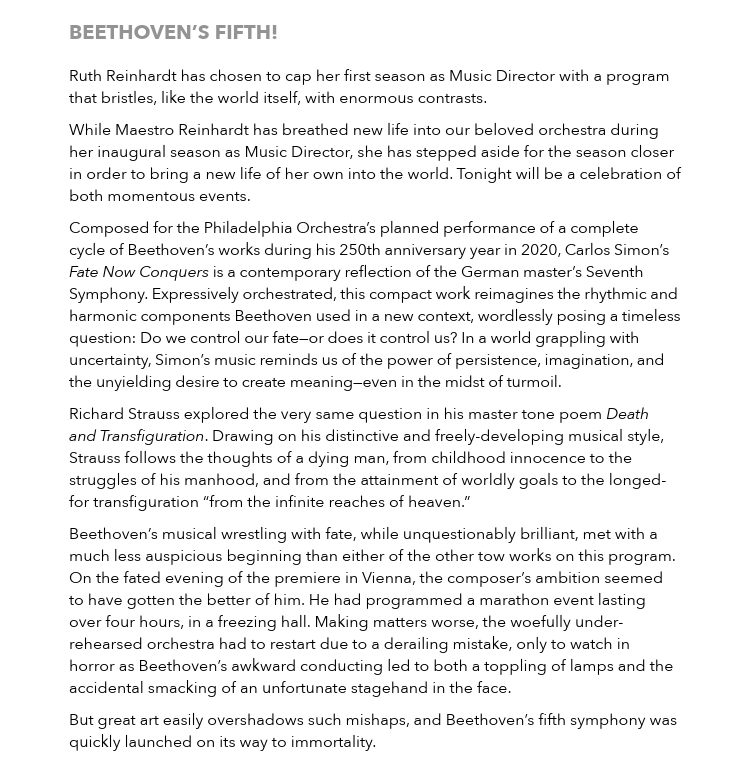
On May 1 & 2, conductor José Luis Gomez and the Rhode Island Philharmonic Orchestra will present BEETHOVEN'S FIFTH.
Title: Tod und Verklärung (Death and Transfiguration)
Composer: Richard Strauss (1864-1949)
Last time performed by the Rhode Island Philharmonic:
Last performed May 2, 1992 with Eleazar de Carvalho conducting. This piece is scored for three flutes, two oboes, English horn, two clarinets, bass clarinet, two bassoons, contrabassoon, four horns, three trumpets, three trombones, tuba, timpani, percussion, two harps and strings.
The Story: When Strauss introduced his youthful Don Juan to the world, he had almost completed his next symphonic poem, Death and Transfiguration. Its literary connection was the outline of a poem by the composer’s friend, Alexander Ritter, in which Death is conceived as both destroyer and liberator. In the poem, the dying man, racked by pain, has fitful glimpses of his childhood and youth. The ambitions and ideals of his younger years pass before him. Death, when it comes, marks the beginning of that for which he had hoped all along. Death, having delivered him from mortality and its sufferings, turns out to be nothing less than a transfiguration – a realization, fulfillment and culmination of all those dreams and longings he had striven for in his earthly life. Stemming from Biblical sources, his personal apocalyptic visions are a part of the Judeo-Christian heritage firing Strauss’s youthful imagination.
His approach to actual composition, however, was cool and detached. Claude Debussy wrote rather disparagingly of Strauss’s self-admitted dependence on literary programs for his symphonic poems: “To make a symphonic poem he (Strauss) takes any idea that occurs to him, thus proving himself to be an extraordinary illusionist who could give points to the most adept of Fakirs…the frequent misunderstandings that occur between composer and listener will certainly not be dissipated by reading those little guide-books in which the letters of the alphabet represent parts of picture puzzles which you try to solve during the performance.”
Debussy was right, of course. Strauss, the self-assured tone painter, joked that the discerning listener might be able to distinguish which of Don Juan’s victims was a redhead or which glass of beer was a Pilsner! But the reason why his symphonic poems remain popular is not because of any graphic musical rendering of objects, character, plot or story, but because the music itself retains its own vibrancy and dramatic strength above and beyond the narrative which inspired it. There is no doubt that in the tone poems, the musical images are extraordinarily rich, colorful and evocative, with the composer revealing himself as absolute master of the resources of the post-Wagnerian romantic orchestra. In doing so, Strauss stretched symphonic form to the extent that it was malleable for his own expressive and dramatic needs, without extending or bending it so far that his tone poems become shapeless.
Debussy felt that the program behind Death and Transfiguration was superfluous with its “ever recurring temptation for verbose explanations. Music simple and unadorned suffices.” Yet he himself could not entirely avoid a descriptive thrust when writing that the opening suggested “the atmosphere of the sepulcher in which alarming larvae appear to move,” and in which “the soul engages in terrible struggles, endeavoring to free itself from the vile body which still holds it to the earth.”
This opening is in fact Strauss’s “De Profundis,” with the first of his two principal themes emerging lugubriously from the nether regions. This later will become forceful, surging and aggressive as it wages unremitting warfare with the romantic, tenderly lyrical second theme first heard so hauntingly on the oboe. Incredible tension is generated as Strauss stretches and contrasts these themes. To be sure, there are moments of respite when the conflict is temporarily postponed. But the combat has to reach feverish depths of dissipation and dissolution before the “transfiguration” theme is finally announced. Even Debussy, ever critical of musical storytelling, here speaks of “the Transfiguration taking place before the eyes of the public, without any trickery beyond the great chords of C major. It is the key which most perfectly conveys the impression of eternity.”
The conclusion does indeed have a magisterial serenity to it, as the music modulates and broadens into the final image of transfiguration, then softens to a warm glow full of peace and contentment.
Program Note by William D. West © 1992. ALL RIGHTS RESERVED.
Recommended Recordings:
Richard Strauss himself recorded Death and Transfiguration with Vienna Philharmonic in 1944. Sonics are vintage and this composer-led performance is curious, but cool. For great sonics and definitive interpretation, turn to George Szell and The Cleveland Orchestra (Sony 1957), Fritz Reiner and the Vienna Philharmonic (RCA/Sony 1959) and Rudolf Kempe with the Dresden Staatskapelle (Warner/EMI 1970). And that's just three. There are so many fine versions: Bernard Haitink, Jascha Horenstein, Pierre Monteux, the list goes on.
Tickets start at $25! Click HERE or call 401-248-7000 to purchase today!