THE STORY BEHIND: Beethoven's Symphony No.5
Share
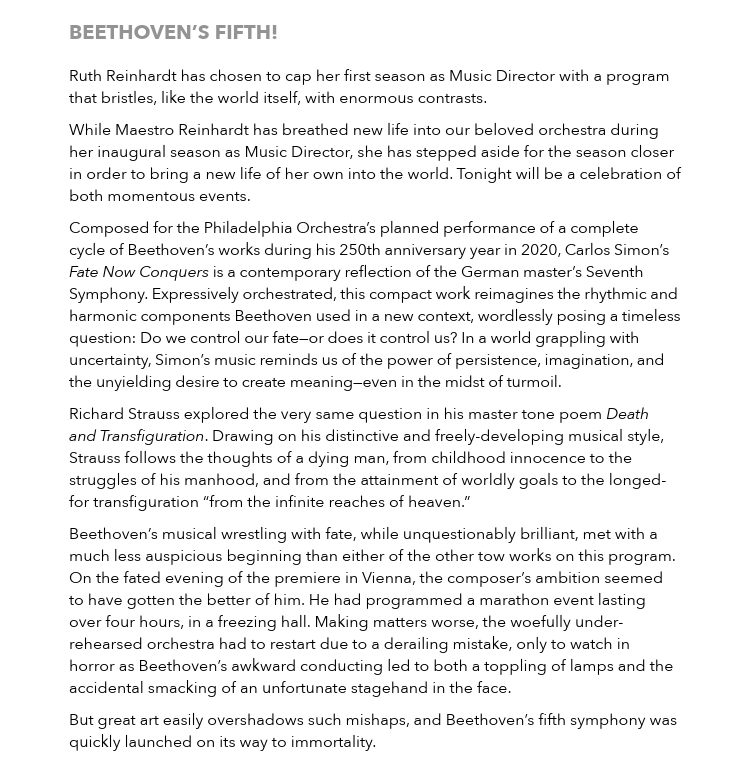
On May 1 & 2, conductor José Luis Gomez and the Rhode Island Philharmonic Orchestra will present BEETHOVEN'S FIFTH.
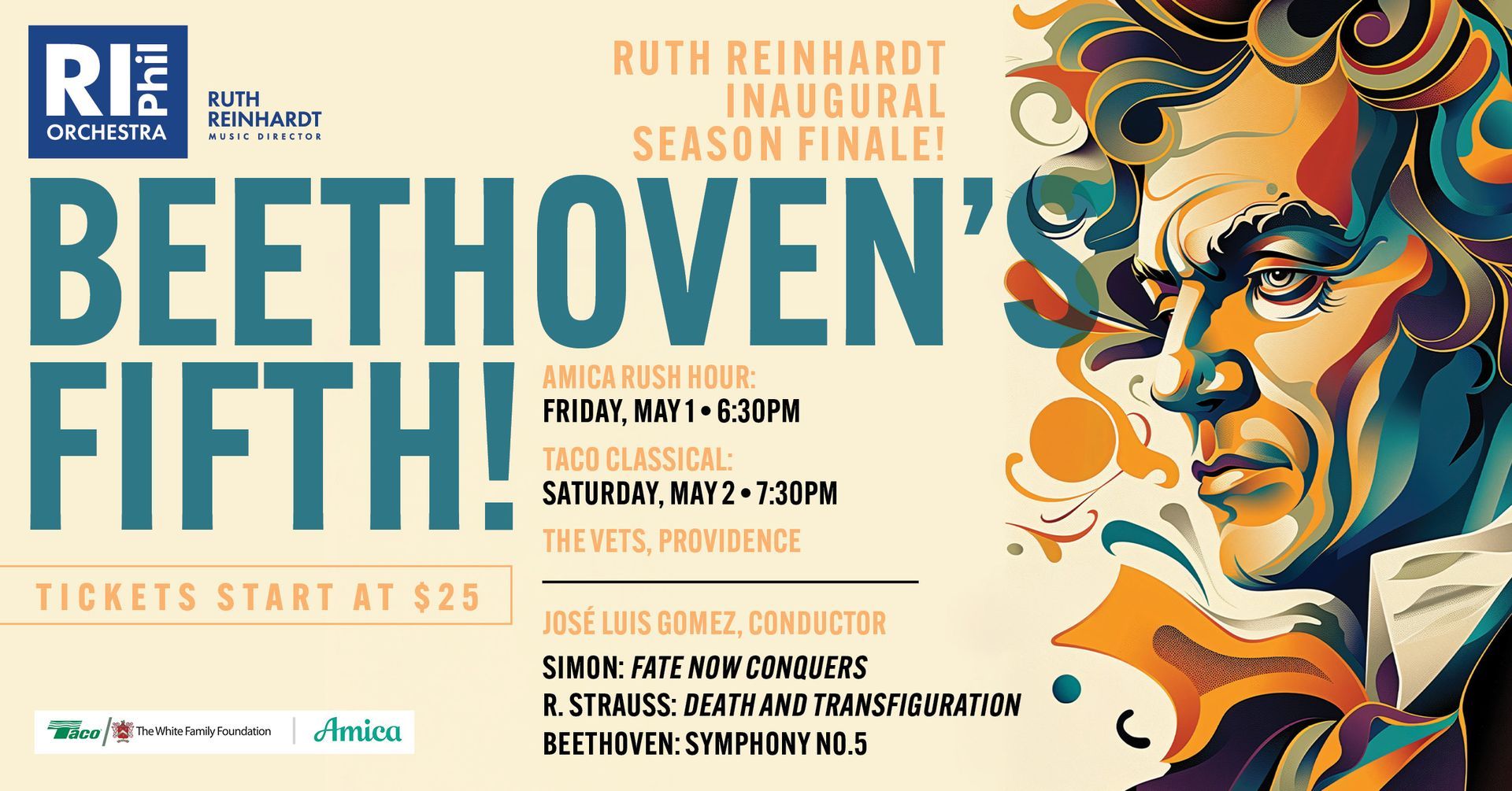
Title: Symphony No.5 in C minor, op.67
Composer: Ludwig van Beethoven (1770-1824)
Last time performed by the Rhode Island Philharmonic:
Last performed January 22, 2022 with Nathaniel Efthimiou conducting. This piece is scored for piccolo, two flutes, two oboes, two clarinets, two bassoons, contrabassoon, two horns, two trumpets, three trombones, timpani and strings.
The Story: Perhaps the biggest challenge when listening to a live performance of Beethoven’s Fifth Symphony is to listen to it as if you’re hearing it for the first time. But the effort is worth it.
At its core, Beethoven’s Fifth is an experimental symphony. The opening is strange, with no clear harmony for quite some time. What key are we really in? But that question soon takes a back seat in the face of even more pressing matters. A revolutionary at heart, Beethoven eschews traditional melody to give this iconic work its distinctive sense of drama, but relies instead on visceral rhythm and imaginative structural details. In this way, he was a hundred years ahead of his time.
The famous four-note motif at the opening serves as the foundation for not just the first movement but, in fact, for the entire symphony. From it, the composer wrings every musical possibility imaginable, endowing the entire work with a stunning coherence. With the stroke of his pen, Beethoven gives history a new idea: even the most minute musical gesture can give rise to a masterpiece of enormous scope. Listen for the startling and lyrically expressive oboe cadenza (about four minutes in) that abruptly halts the torrent of rhythm. This delicious moment gives even greater meaning to the motif as it returns like a relentless hammer in the coda that follows.
In the second movement-
Andante con moto – Beethoven elegantly spins a series of four variations on two main ideas. Violas and cellos start by venturing into an unexpected key (A-flat major), with one of the composer most memorable melodies. A contrasting, more assertive theme in an equally unexpected key (C major) is then offered by the clarinets, flute and bassoons. Beethoven masterfully weaves double variations on both of these ideas, while never losing sight of the underlying rhythmic energy of the motif from the first movement.
The third movement takes the (then) traditional idea of a dance movement and whips it up into an enigmatic
scherzo. Opening with a mysterious arpeggio in the low strings, unison horns soon interrupt to remind us what this bold symphony is all about. Once the matter is settled, the cellos and double basses launch into a ferociously difficult bit of counterpoint with the tenacity of feral animal. Ultimately, a truncated version of the opening returns, but even softer now, setting the stage for a moment of true musical magic.
Beethoven bridges the transition into the last movement with a delicate solo passage in the first violins, supported by gently throbbing basses and timpani, and sustained pianissimo notes in the seconds and violas. Then, in one of the most unnerving and tension-building passages in all the literature, a snake-like melody slithers and builds until, in a moment of unbridled joy, the trombones, contra-bassoon, and piccolo (instruments usually reserved only for the military or operas back in the day) finally make their long-awaited entrance. Echoes of “La Liberté” - a French revolutionary hymn that Beethoven certainly knew – cry out, and the whole orchestra responds with familiar music that is now made new by its context. All hints of darkness are expelled. At the end, 54 measures of emphatic C major chords mark the completion of the journey from strife to triumph.
Program Note by Jamie Allen © 2025. ALL RIGHTS RESERVED.
Recommended Recordings:
There are well over 100 recordings of Beethoven’s Fifth Symphony, beginning with Francois Ruhlman in 1910 followed by the legendary Arthur Nikisch in 1913, a fascinating historical document with the Berlin Philharmonic now a couple years closer to the work’s 1808 premiere than to our own time. Every major conductor has set it down, likely more than once. The “go to” recording is Carlos Kleiber’s titanic account with the Vienna Philharmonic from 1975 (Deutsche Grammophon) that to this day astonishes. Glenn Gould (Sony) recorded Franz Liszt’s blistering transcription for piano. And several recordings have been made on instruments of Beethoven’s time by Roger Norrington (EMI), John-Elliott Gardner (Deutsche Grammophon), Christopher Hogwood (Decca) and the conductor-less Hanover Band (Nimbus.) All are interesting, still it’s Carlos Kleiber that arguably towers above all others.
Tickets start at $25! Click HERE or call 401-248-7000 to purchase today!